Choose a neighbourhood, then explore on foot
Choose a small group of places instead of trying to fit the whole directory into one walk. The central streets, canals and courtyards combine naturally; parks farther from the centre and the Kaag lakes need their own travel plan.
Use each location's guide for its map, background and access information. An outdoor view of a building does not mean its interior is open: churches, university buildings and lived-in courtyards have different visiting conditions.
Canals and photo stops: Rapenburg and Nieuwe Rijn
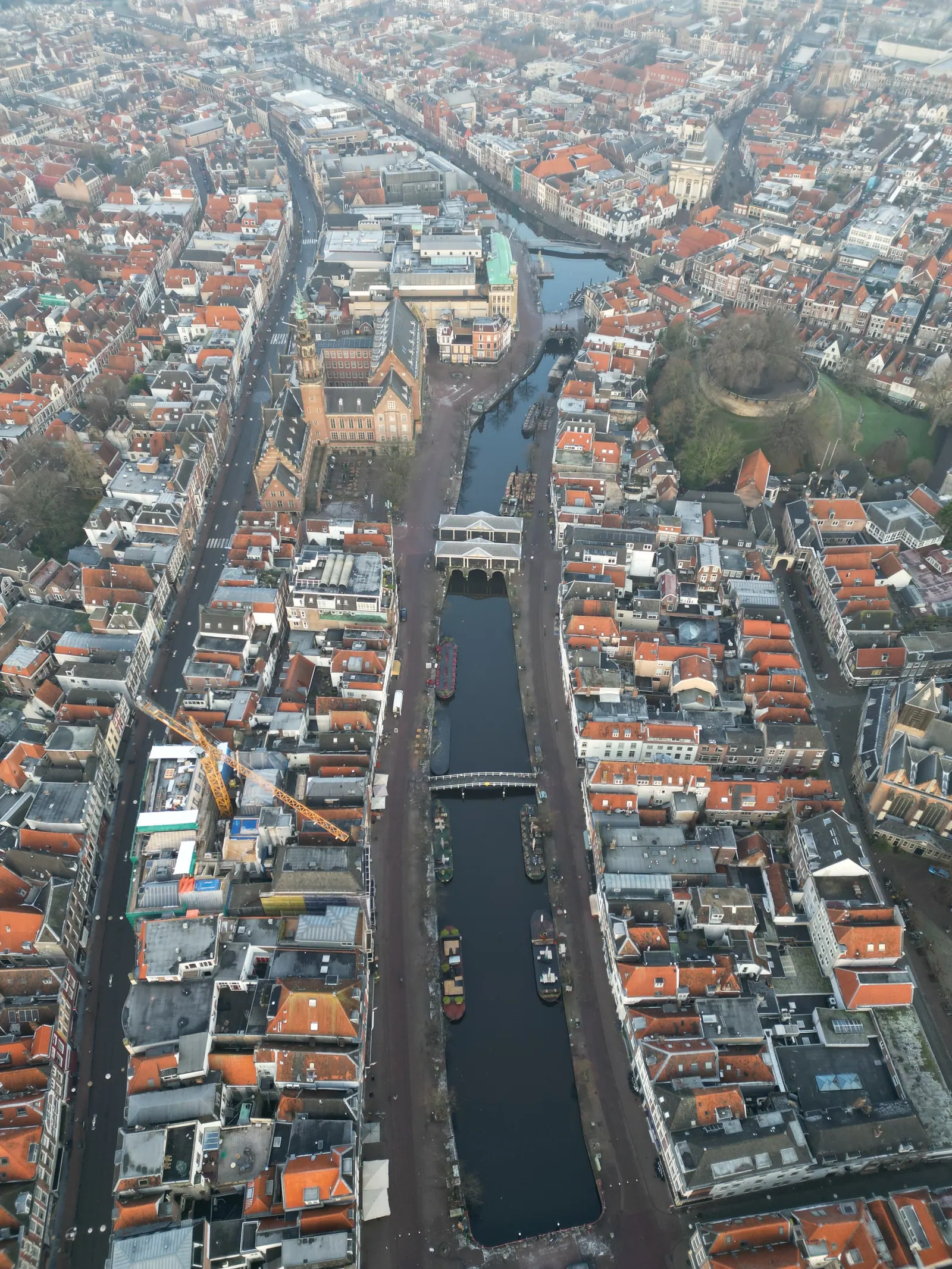
Choose Rapenburg for canal-side façades and university surroundings, or Nieuwe Rijn for the waterfront around Koornbrug and the Fish Market. These are useful starting points for an architecture or photography walk, rather than a list of places to rush between. Keep bridges, cycle routes and residents' doorways clear when stopping for a photograph.
Smaller heritage stops around Pieterskwartier and Rapenburg
Look beyond the large monuments to the Latin School on Lokhorststraat and the Jean Pesijnhof beside Pieterskerk. Continue towards Rapenburg for Bibliotheca Thysiana and use the Doelenpoort guide for a nearby gate stop. This selection connects school, courtyard, library and gateway without repeating the same type of sight.
Treat hofjes as residential spaces: follow signs, keep quiet and leave a closed gate closed. Bibliotheca Thysiana's interior requires an appointment; check the university's visitor information before planning to go inside.
Combine Haarlemmerstraat with Hartebrug Church
A shopping walk can also include architecture. Hartebrug Church stands on Haarlemmerstraat, so its façade is a natural stop while exploring the street. If you want to enter, check the parish information and respect services and people coming for quiet reflection. Use the shopping guide for other streets and independent shops rather than treating this location directory as a shop listing.
Turn your selection into a walking route
For a ready-made sequence, choose the Rembrandt walk for places connected with the artist's Leiden years, or the hofjes walk for courtyards and quiet lanes. Both guides explain the route and practical limits. Keep museum visits separate in your timing, and use the wider walking-routes guide if you want a different theme.
Continue exploring Leiden
- BreestraatThe Breestraat is Leiden's stately main street: a wide avenue of shops, the Renaissance façade of the City Hall and the old courthouse with its blindfolded…
- BeestenmarktThe Beestenmarkt is Leiden's terrace square: a leafy waterside plaza where students, families and visitors gather in the sun.
- PieterskerkDiscover Pieterskerk Leiden: 900 years of history, Gothic vaults, ancient grave stones and stories of the Pilgrims and Rembrandt, with visitor information.
- Hooglandse KerkVisit Hooglandse Kerk, Leiden’s light-filled Gothic church beside De Burcht. See its unfinished history, location and current visitor information.
- RapenburgWalk Rapenburg, Leiden’s famous historic canal, lined with museums, the university, Hortus botanicus and 17th-century mansions. Map and visiting tips.
- Nieuwe Rijn & Fish MarketVisit Nieuwe Rijn in Leiden for the Wednesday and Saturday market, historic Fish Market, Koornbrug, canal views and waterside terraces.
- De WaagDe Waag on the Aalmarkt is Leiden's classical weigh house, designed by Pieter Post, with a frieze of porters above the entrance.
- Leiden City HallLeiden City Hall combines a Renaissance façade on Breestraat, built in 1595–1596, with the twentieth-century civic building around Stadhuisplein.
- MorspoortThe Morspoort is one of Leiden's two surviving city gates: an octagonal domed gateway from 1669 on the western edge of the centre.
- ZijlpoortThe Zijlpoort of 1667 marks the eastern boundary of old Leiden, with the harbour and its houseboats spread out in front.
- HaarlemmerstraatThe Haarlemmerstraat is Leiden's longest shopping street: more than a kilometre of shops, from big chains to local specialists.
- Van der WerfparkThe Van der Werfpark is the green city garden in the heart of Leiden, laid out on the site of the 1807 gunpowder disaster.
- Academy BuildingThe Academy Building on the Rapenburg has been the heart of the oldest university in the Netherlands since 1581, complete with the famous Sweat Room.
- Leiden almshouse courtyardsBehind unremarkable doors lie dozens of hofjes: small courtyard gardens surrounded by cottages, built as charity housing for the elderly.
- KoornbrugSee Koornbrug in Leiden, the historic covered bridge over the Nieuwe Rijn, beside the market and Fish Market, with location, history and nearby sights.
- De Put windmillDe Put is the white post mill on the Rhine, built as a replica of the mill Rembrandt saw from his birthplace.
- SingelparkThe Singelpark is the six-kilometre green ring around Leiden's old town, running over the former ramparts and along the water.
- PlantsoenThe Plantsoen is the romantic park on the eastern edge of the old town, with tall trees along the water of the Herensingel.
- MarekerkThe Marekerk is the Baroque church on the Lange Mare: a bright, domed church often overlooked, yet one of the finest in Leiden.
- WeddesteegWeddesteeg is the narrow alley where Rembrandt van Rijn was born in 1606 — a small place with a big story.
- GarenmarktVisit Garenmarkt in Leiden, a historic square above the city-centre parking garage, near De Burcht and Hooglandse Kerk, with location and visitor tips.
- Leiden canalsThe Leiden canals form the water network that cuts through the centre: a system of quays, bridges and monuments that gives the city its character.
- Leiden Old TownLeiden's old town is the compact historic heart of the city: canals, monuments, almshouses and museums within a fifteen-minute walk.
- Saturday MarketVisit Leiden's Saturday Market on the Nieuwe Rijn for cheese, fish, flowers, stroopwafels and Dutch treats, with location and visitor tips.
- Leidse SchouwburgThe Leidse Schouwburg is Leiden's monumental theatre on the Oude Vest, with a rich programme of drama, dance and music.
- MeelfabriekThe Meelfabriek is the regenerated industrial complex on the Zijlsingel: a monumental building that now combines hospitality, events and homes.
- GalgewaterThe Galgewater is the wide stretch of water on the west side of the old town, with De Put windmill, rowing clubs and the view Rembrandt knew as a child.
- GravensteenThe Gravensteen beside the Pieterskerk is Leiden's oldest prison and now a university building, fronted by one of the quietest little squares in town.
- LodewijkskerkThe Lodewijkskerk is Leiden's Roman Catholic Church of Saint Louis, standing beside the Steenschuur canal near Van der Werfpark, the Rapenburg and the…
- StadsgehoorzaalThe Stadsgehoorzaal on the Breestraat is Leiden's concert hall: classical music, pop, comedy and the annual 3 October programme under one roof.
- Leidse HoutThe Leidse Hout is the green estate park on the north side of Leiden: old beech trees, a tea house, a petting farm and wide walking paths.
- Polderpark CronesteynPolderpark Cronesteyn is Leiden's largest nature park: reed beds, meadows, bird hides and a tea house, ten minutes by bike from the centre.
- Kaag LakesThe Kaag Lakes are the watersports area just north of Leiden: sailing, sloop trips, small islands and waterside terraces.
- Leiden Centraal stationPlan your trip through Leiden Central Station with live NS train information, luggage lockers, OV-fiets facilities and directions towards the old town.
- Latin SchoolThe Latin School on Lokhorststraat is the historic school building where Rembrandt studied from 1616 to 1620, in the heart of the Pieterskwartier.
- Jean PesijnhofJean Pesijnhof is a lived-in almshouse courtyard founded in 1683 beside Pieterskerk, on a site closely connected with the English Pilgrims' years in Leiden.
- Hartebrug ChurchHartebrug Church on Haarlemmerstraat is a Neoclassical Roman Catholic church built in 1836 and locally known as the Coeliekerk.
- DoelenpoortDoelenpoort is an elaborately carved sandstone gate from 1645, crowned by Saint George defeating the dragon.
- Bibliotheca ThysianaBibliotheca Thysiana on Rapenburg is an exceptionally preserved seventeenth-century library containing the book collection of Johannes Thysius.